What is Aging, Actually?
A medical student’s anatomical guide to your face’s slow disintegration

What Is Aging, Actually?
Let’s start with what aging is not.
Aging is not a hydration problem. It is not a niacinamide deficiency. It is not the absence of a $450 eye cream containing placenta. Your tear trough deformity is not the result of you choosing the wrong serum. It is, more accurately, the result of you slowly approaching death.
I say this with love, because the truth keeps us hot.
There is no denying that our collection of compounds, cosmeceuticals, ingredients, actives, peptides, polymers, chemical exfoliants, acids, bases, pig piss, whatever, have shown to have X,Y,Z property in double blind, case-controlled studies, and has been FDA approved. Great.
The supreme court also found that pizza was a vegetable.
If you’re going to spend money trying to fix your face, it helps to know what’s actually happening to it. So before we get into what works — filler, Botox, lasers, the whole arsenal — we need to talk about what you’re trying to correct.
Because most of the things people are sold for “anti-aging” are aimed at the wrong layer of the problem.
For anyone new here, thanks for joining us. I write about skin care. Infrequently. But well enough to justify giving me your email.

The visible stuff (the skin)
The first changes you notice in the mirror are happening in the dermis and epidermis. These are the layers most skincare brands are talking about when they say “anti-aging,” because they’re the layers a topical product can theoretically reach. They include:
Thinning of the dermis and epidermis. This is what produces the crepey, papery quality of older skin. Less tissue, less cushion, more visibility of what’s underneath.
Reduced collagen levels. Collagen is the structural protein that gives skin its tensile strength. Production declines roughly 1% per year after age 25. LOL.
Dermal elastosis. The elastic fibers in your skin become disorganized and damaged with age and sun exposure, which means skin loses its ability to snap back into place. This is the mechanism behind wrinkles and sagging.
Actinic damage. Sun damage. The single largest modifiable contributor to everything on this list.
These are the changes topical products can — occasionally, modestly, with the right ingredient at the right concentration in a stable formulation — actually influence. But not really. The one product that works?
Retinoids.
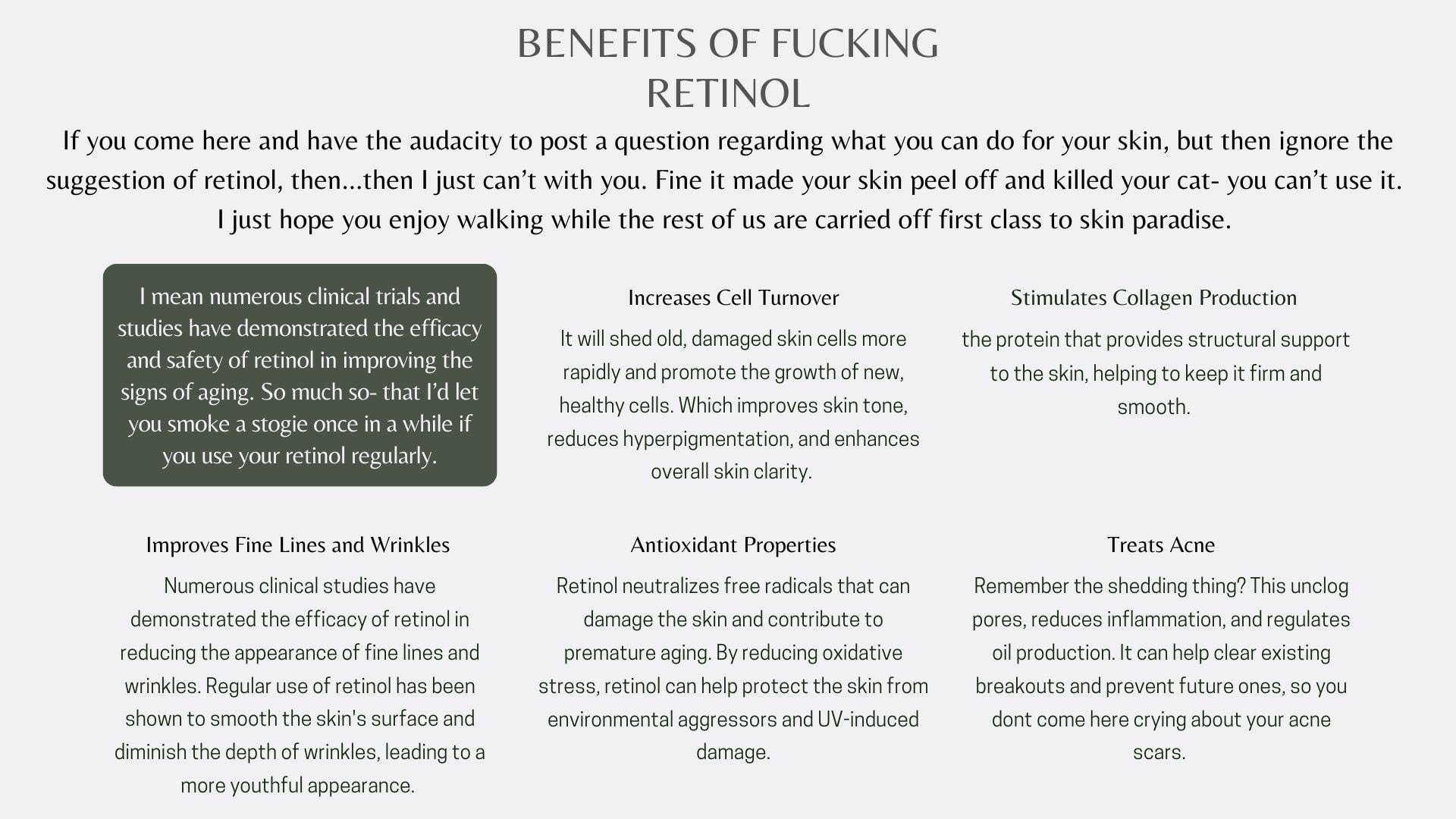
Use retinol.
The structural stuff (everything underneath)
The dermal changes are the part of aging marketed to you. The structural changes are the part your dermatologist is actually thinking about when you walk in asking why you look tired.
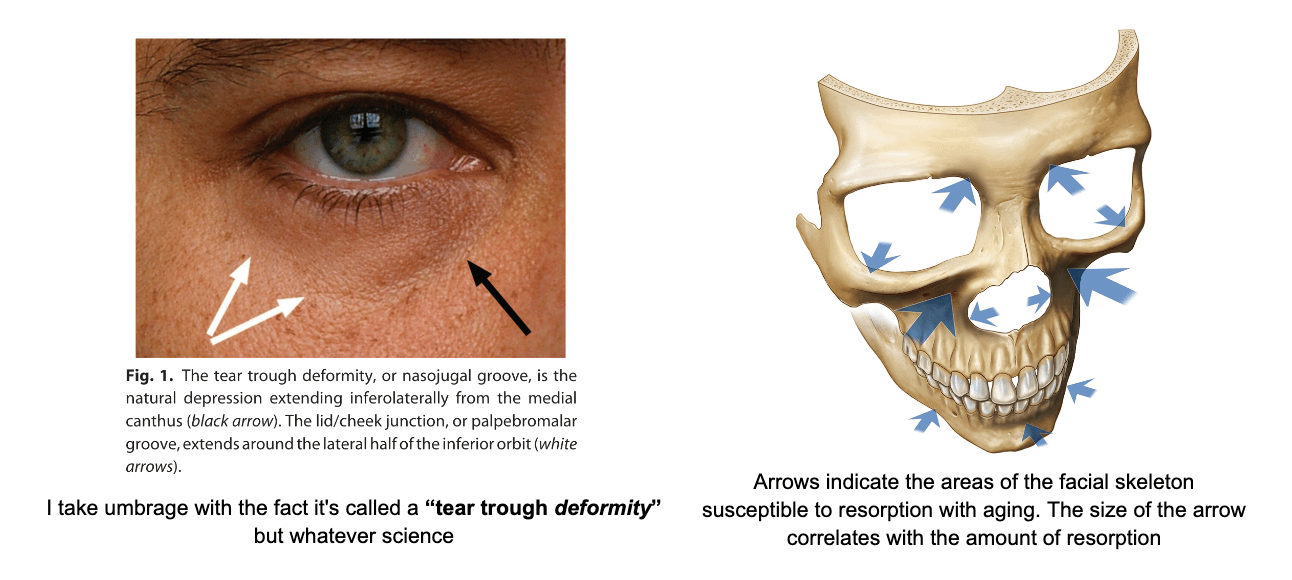
Bone resorption. Your skull is not static. The bony architecture of your face is actively losing mass with age, and it’s not losing it evenly. The orbital rim resorbs. The maxilla resorbs. The mandible resorbs. The bones of your face are quietly receding behind the soft tissue, and the soft tissue, deprived of its scaffolding, sags into the space the bone used to occupy. This is why under-eye hollows appear before any wrinkle does. It’s not the skin — it’s the bone behind the skin retreating.
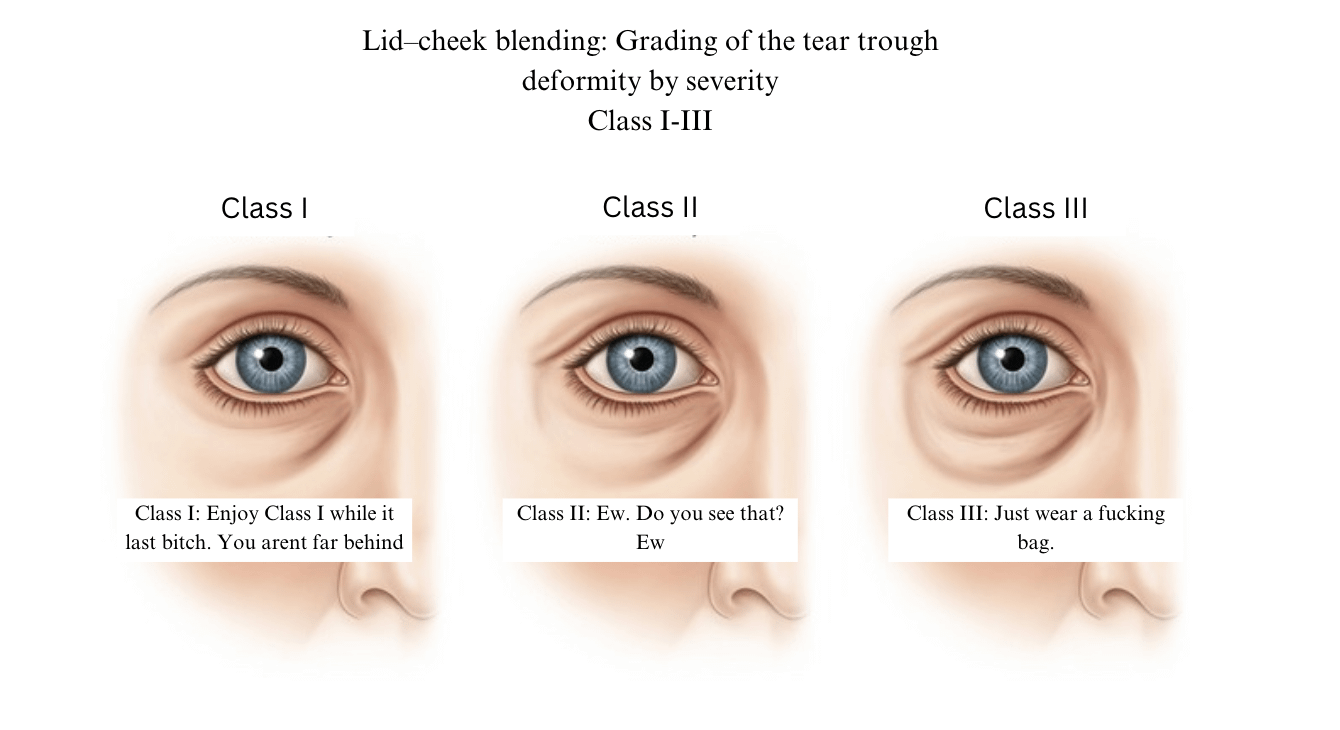
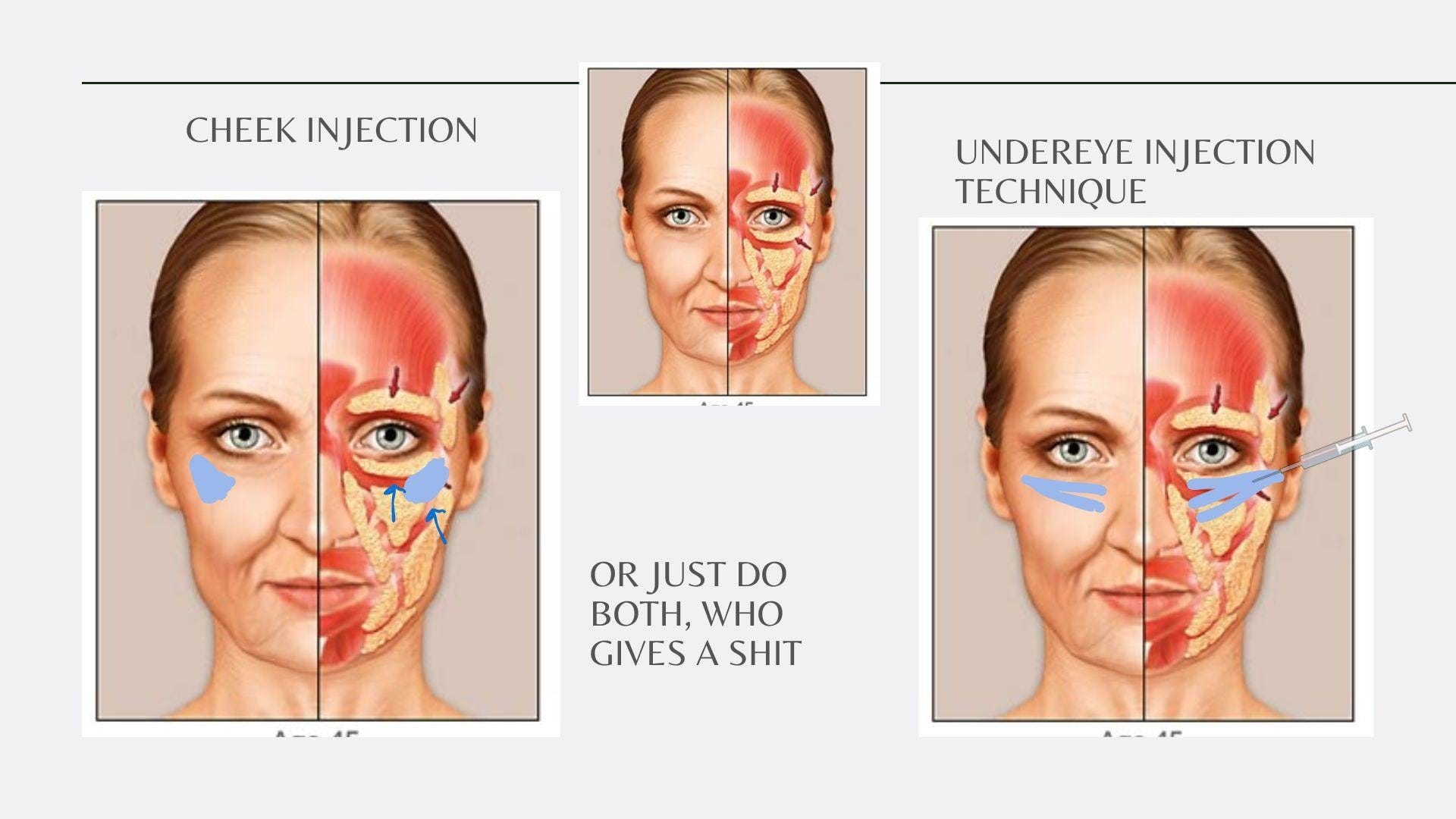
Facial fat loss. Your face has discrete fat compartments — anatomically distinct pockets of subcutaneous fat that give the face its youthful contour. These compartments don’t deflate evenly. The temples hollow. The cheeks flatten. The peri-orbital fat redistributes. The result is what people describe as looking “drawn” or “gaunt” — and no amount of topical hydration is going to refill a fat compartment.
Laxity of the facial retaining ligaments. Your face is held in position by a series of retaining ligaments — basically the structural seams that anchor your soft tissue to the underlying bone. Imagine pillowcases sewn to the face: they allow movement, but they’re what keep everything from sliding around. With age, these ligaments weaken and stretch. The pillowcases sag. Entire structural regions descend — the cheek falls, the jawline blurs, the jowl appears.
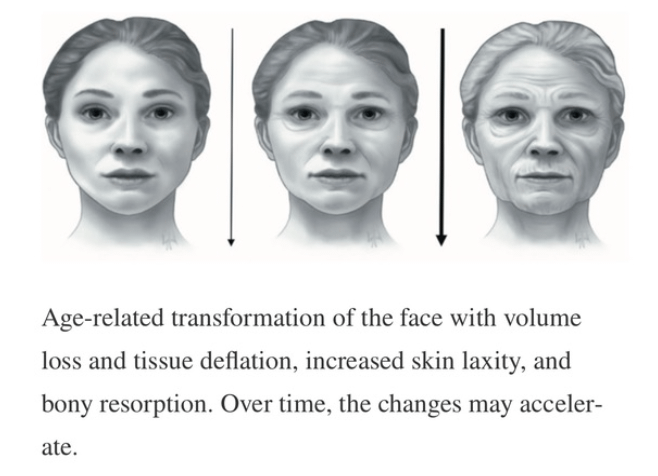

Put together: your bones are receding, your fat is migrating, and the structural seams holding the whole thing up are losing tension. It’s draping over an architecture that’s quietly disintegrating beneath it.
Super cute, I know.
The compounding factor (your face doing face things)
On top of all of this, there’s what the literature calls “age-related increases in facial strain” — which is the academic term for using your face to have a face. Every expression you’ve ever made has been etching itself into the skin via repeated muscle contraction. Smile lines, frown lines, forehead lines, crow’s feet. These start as dynamic creases (visible only with movement) and gradually become static creases (visible at rest). The skin, having been folded along the same vectors thousands of times, eventually keeps the fold.
This is the layer Botox addresses — by reducing the muscle contraction that creates the strain. But Botox doesn’t stop the bone from resorbing or the fat from migrating. Nothing topical does. Nothing injectable fully does either.

So regardless of whether you’ve been wearing SPF out the womb and sleeping upside down, you will still age. The process is mitigated, not prevented.
Why this matters before you spend any money
When someone posts a photo on a skincare forum asking what should I do about this?, the useful answer depends entirely on which layer of the face the “this” is happening in.
If the issue is texture, tone, fine surface lines, or pigment irregularity → that’s an epidermal/dermal problem, and topicals and lasers are the relevant tools.
If the issue is volume loss, hollowing, or shadows that don’t go away when you change the lighting → that’s a structural problem, and filler is the relevant tool.
If the issue is expression lines or muscle-driven creases → that’s Botox territory.
If the issue is laxity, sagging, or descent of entire structural regions → that’s the deep-tissue layer, and you’re looking at energy-based devices (RF microneedling, ultrasound, etc.) or, eventually, surgery.
No amount of niacinamide will tighten a retaining ligament.
This is the entire reason cosmetic dermatology as a field exists. The interventions are organized by layer. The serious ones go deeper than your bathroom counter can.
Where this leaves us
If you’ve read this and felt mildly horrified, good. The horror is the point. You can’t make smart decisions about what to do with your face until you understand what’s actually happening to it.
The good news, there are some preventative measures which can be taken. If you are not already doing so:

Also you might not like hearing this, but if you’re reading this— you’re likely a candidate for filler. I will strongly urge you to investigate doing the botox and filler combo but for now if struggling with the mentioned problem, then I would say filler.
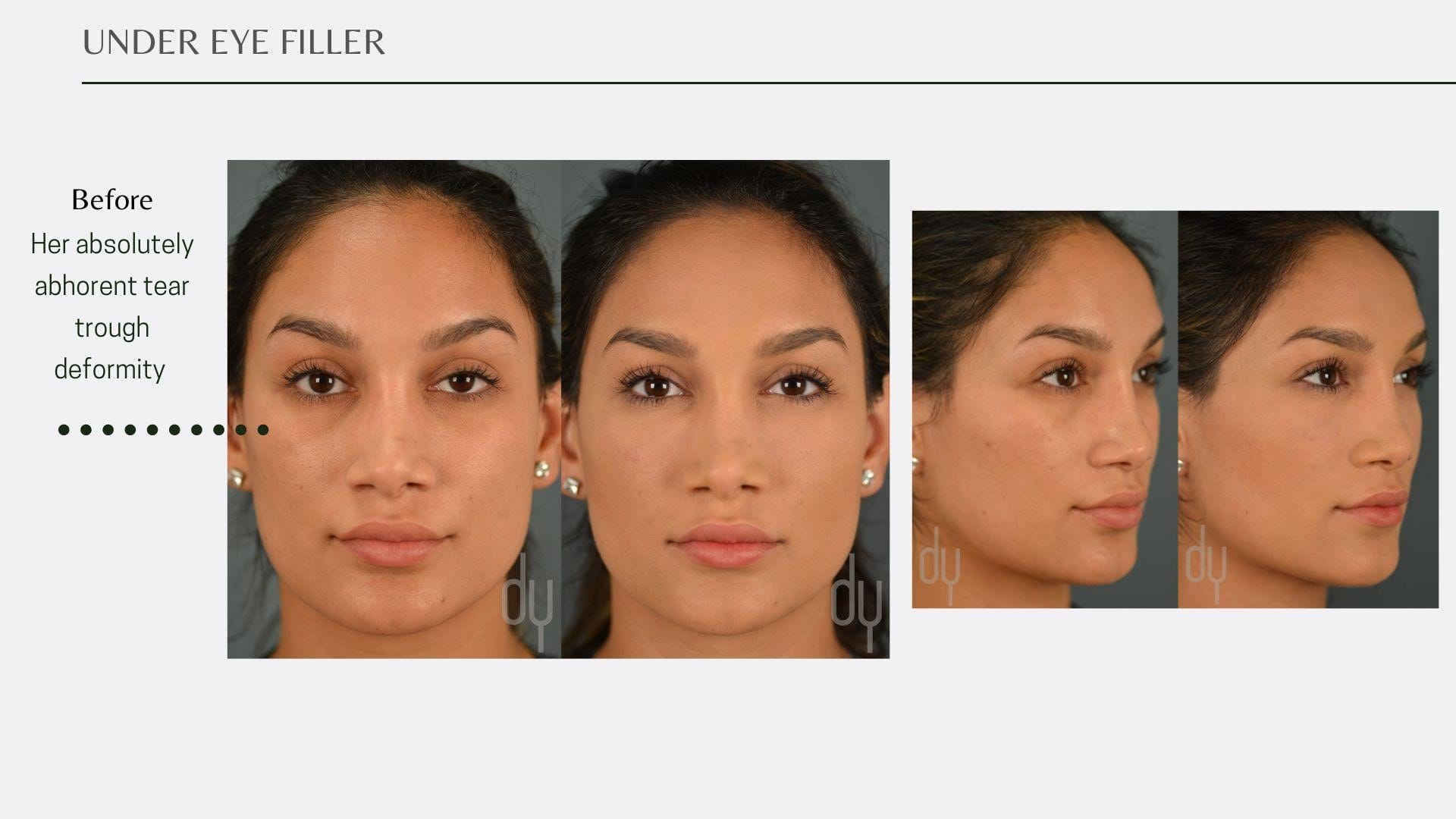
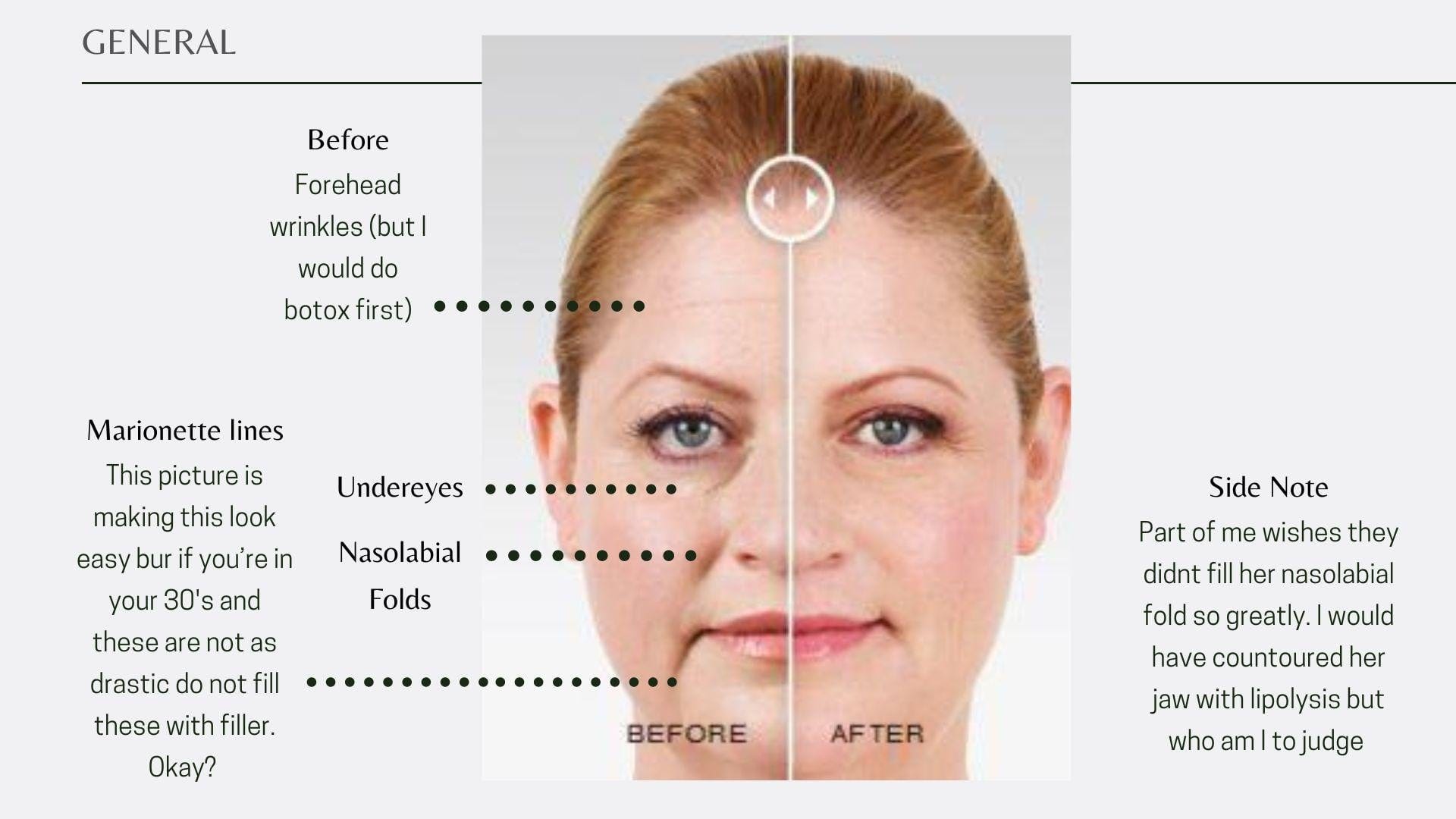
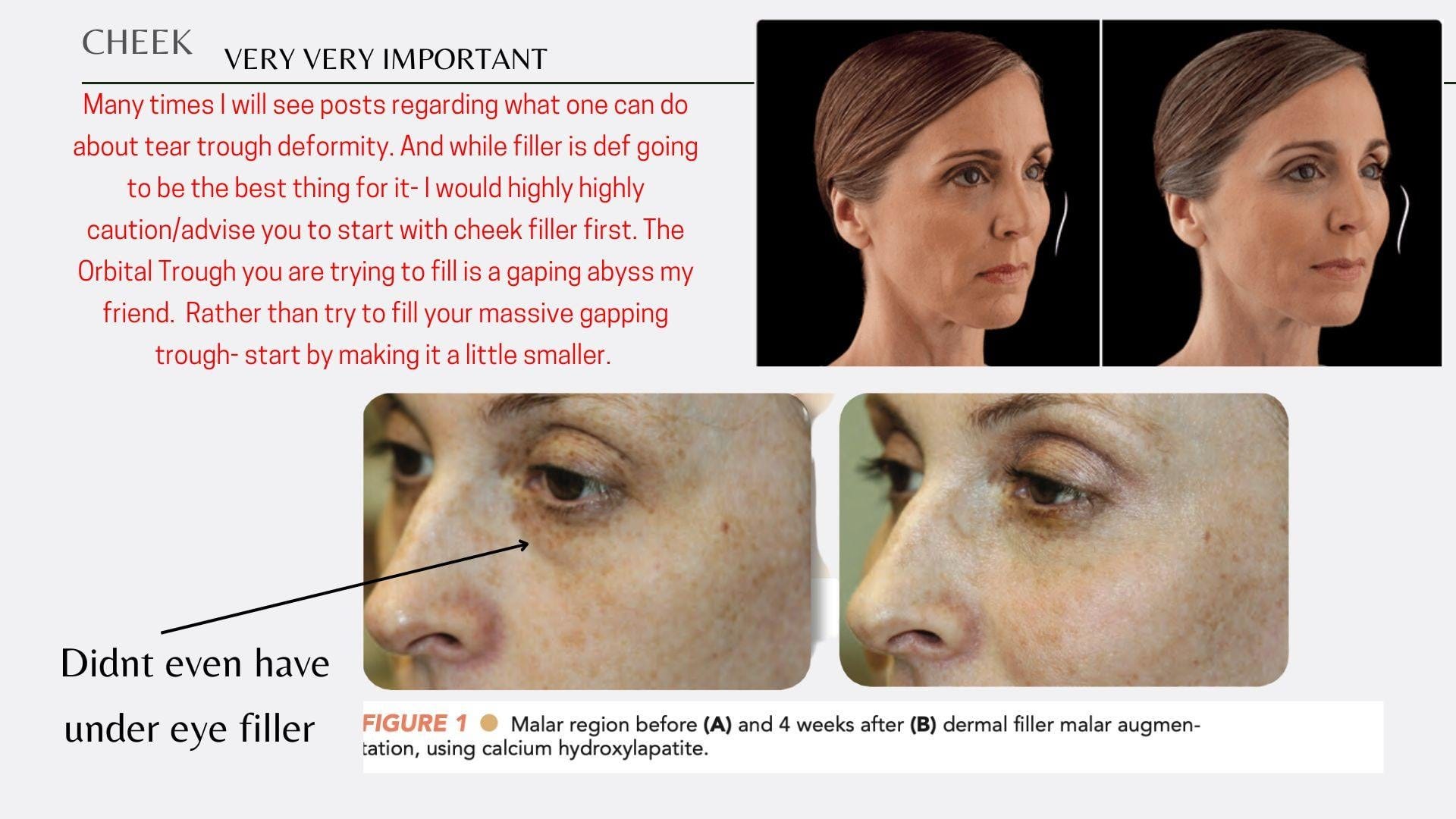
Best to use before and after pictures. I tried find photos where only filler was used- but this isn’t my day job. So unless you wanna pay me, take these images with a grain of salt.
Other than that, mic drop. Peace out.