
A Guide to Botox
everything you should know about botox, explained with as much clarity (and honesty) as possible

Disclaimer
This information is brought to you by a medical student who taught herself how to do her own Botox. The functional equivalent of homeschooling, but for a medical procedure with needles.
So consider this your official disclaimer: this is not medical advice.
I have, however, done a little med school. I have dissected a human being, or cadaver if you want to get technical, face included. And I have paralyzed my own face enough times to have something to contribute.
With that stacked résumé of logic, I dive in.
How does Botox work?
What areas can be treated with Botox?
Is Botox safe? Is it possible to develop immunity?
What does the procedure entail? Is it painful? downtime?
How long does Botox last? So we can manage expectations and plan future treatments.
When will I see results?
Can Botox be used for other purposes besides cosmetics? Do you have migraines, excessive sweating, jaw clenching?
Are there any alternatives to Botox?
Who is a suitable candidate for Botox? Can I get it while pregnant or breastfeeding?
How much does Botox cost?
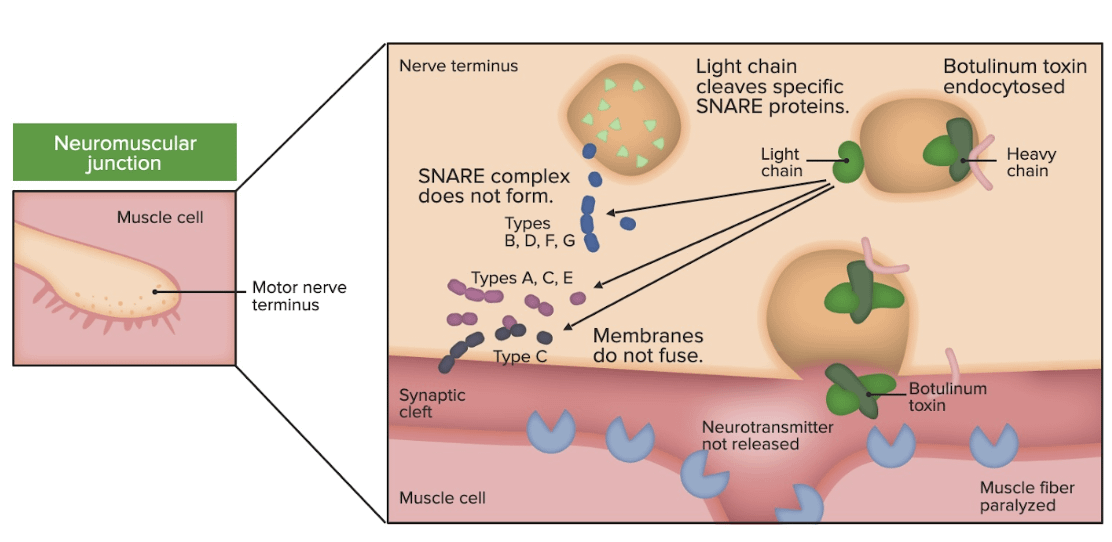
How does Botox work?
Botox is a neurotoxin derived from a bacteria (Botulinum-A) that:
Binds to your motor neuron.
Blocks acetylcholine from doing its thing.
Prevents the muscle from contracting.
I’m happy to cover the SNARE protein and it binding in the synaptic vesicle— but its unnecessary and at that level of physiology gets a little dry.
If curious feel free to ask.
To make a vial of neurotoxin you need the following 3 components:
The Active Neurotoxin (e.g., botulinum toxin type A or B).
A Carrier Protein (commonly human serum albumin, or in Daxxify’s case, a synthetic peptide) to help protect and transport the toxin.
Additional Stabilizers (such as sodium chloride, lactose, or sucrose) to maintain the product’s stability and shelf life.
Each of current, biggest brands on the US market differ by one of the ingredients above, i.e.
Botox: Serum Albumin (HSA) and sodium chloride
Dysport: Human Serum Albumin and lactose
Xeomin: Human Serum Albumin and sucrose
Jeuveau: Human Serum Albumin and sodium chloride
Daxxify: Proprietary 35–amino acid synthetic peptide (rather than albumin)
If your wondering which one to go with, it honestly doesn't really matter especially for your first treatment. Dealers choice is usually a safe bet.
Now the best part is that botox doesn’t bind there forever, AND there is a dose dependent curve: meaning the more you inject the less movement you will have.
Botox is movement modulation, not simply “freezing.”
If you’re worried about looking artificial or “frozen,” don’t be. Through selective paralysis, injectors can modify the dosing to achieve varying degrees of muscle relaxation. You can soften a muscle, weaken it, or fully freeze it, depending on dose and placement.
Your face is a collection of muscles pulling in different directions, and Botox lets us modulate those pulls. We don’t have to stop them entirely — which is where “baby Botox” and “preventative Botox” come in: smaller doses, lighter touch.
Wrinkle reduction is the downstream effect, not the mechanism of action. Which is why the same drug can address expression lines, facial asymmetries, masseter slimming, certain TMJ-related symptoms, and more.
There’s a long-term logic to this. Less repeated movement means fewer lines getting carved into the same places over and over. Existing creases can soften, and new ones form more slowly. That’s the whole premise of preventative Botox: interrupting the repetitive facial choreography that eventually turns expressions into static lines.
It’s why it’s never too late to get it — or too soon to start.
Within reason, obviously. Personally, if you’re old enough to buy alcohol and you want Botox, so be it. But static lines — the kind that catch that gross little layer of concealer — are the first signs of aging, and they start fucking early.
Sorry you used your face.
What areas can be treated with Botox?
Literally whatever the fuck you want you gorgeous human being.
We can start with what's been FDA approved for, which is actually just the upper portion of the face, but don’t let that stop you.
The muscles in your face can be categorized as either an “elevator” or a “depressor”. They either contract upward or they contract downward. But of course, not as simple as that.
Take the orbicularis oculi—technically a depressor, but really it’s a circular muscle wrapped around your eye like a camera lens. It contracts in a way that’s more nuanced than just “downward.” Like a lens closing, it tightens concentrically, pulling your eyelid shut and softening everything around it. Here take a look:
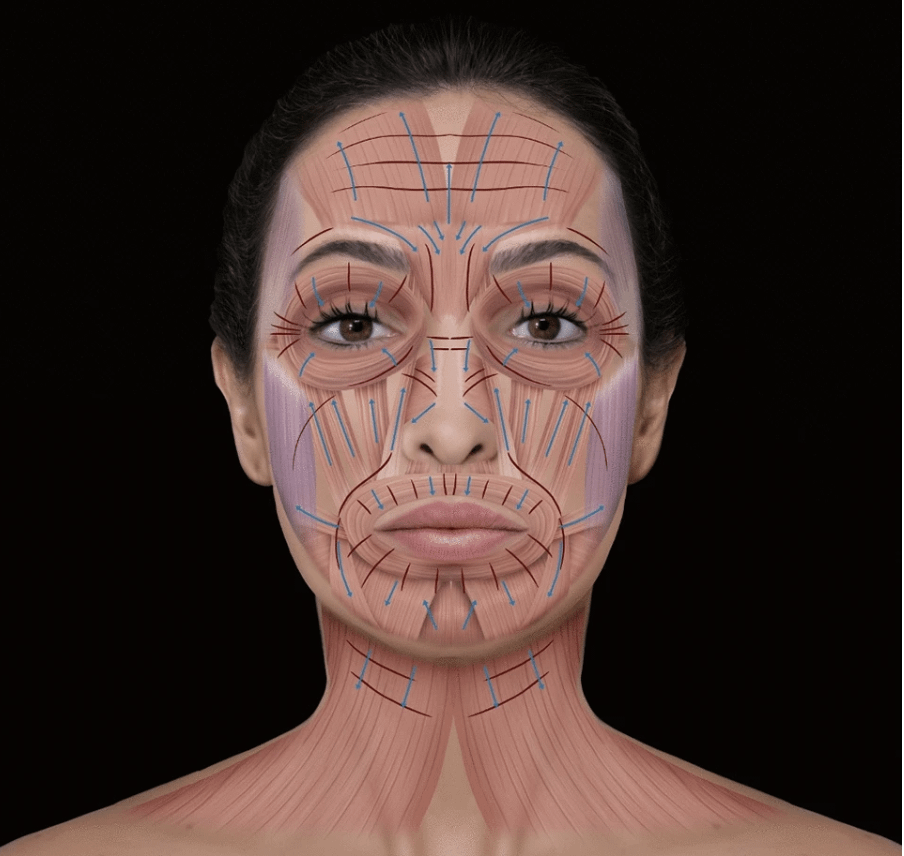
These are the muscle strength vectors of the facial muscles. The arrows show the direction of muscle force, and the expression lines you see on the skin form perpendicular to these arrows.
Over time, injectors have experimented and found that injecting along the muscle’s vector of action produces the most natural results. This approach can soften or eliminate the expression lines everyone complains about.
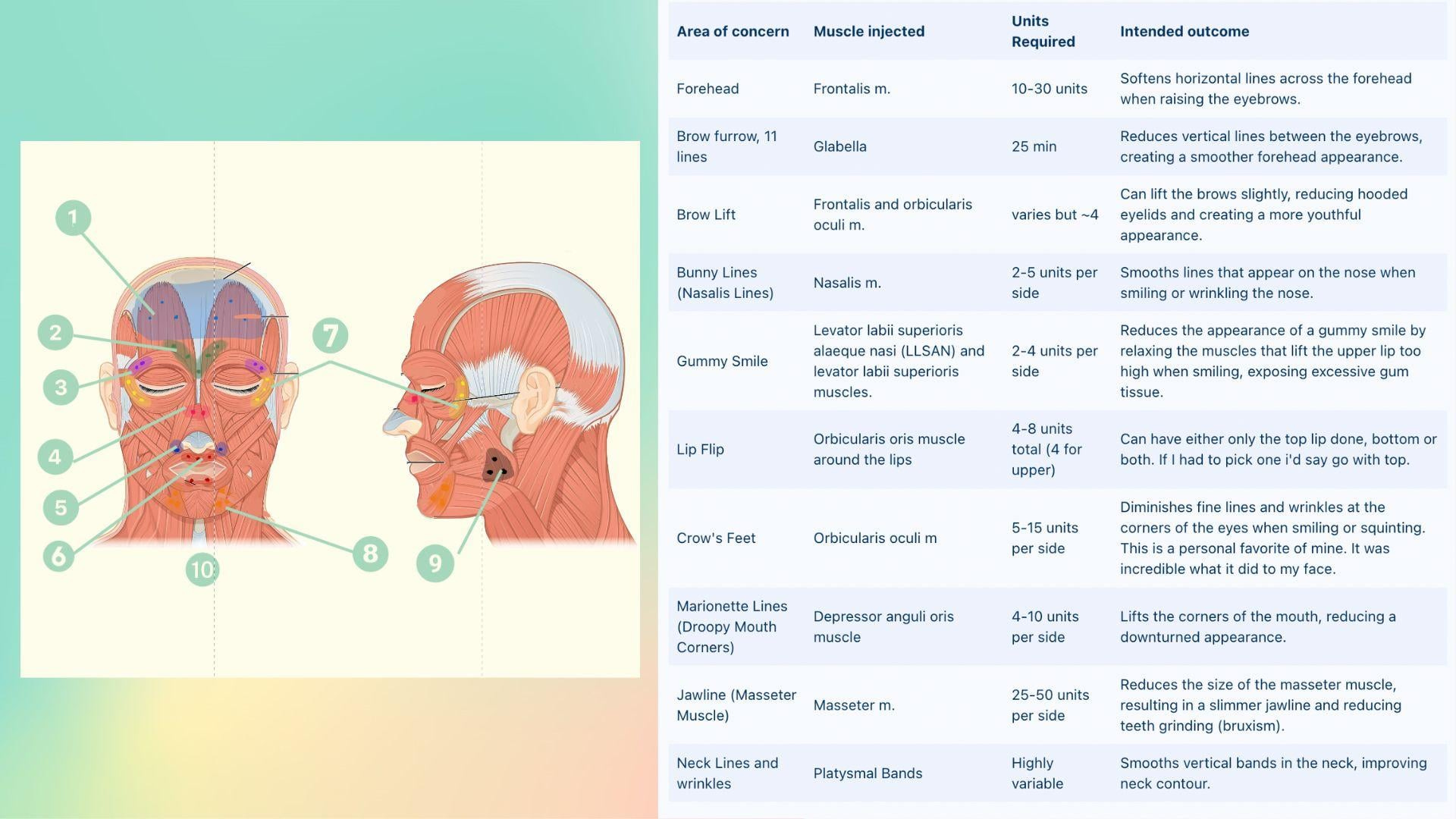
Below is an injection map. When you get Botox, your injector will log where each injection was placed and how many units were used. This map serves as a guide for:
Talking with your injector about areas of concern
Understanding what effects to expect
Estimating cost based on the average units used for each area
Is Botox safe?
Okay boring, but whatever.
Just like anything, there are potential complications—but they’re incredibly rare. BoNT/A is one of the most widely studied drugs in the world, and while safety and efficacy studies are overwhelmingly positive, there are a few potential adverse effects. Thankfully, no reported deaths have ever occurred from cosmetic use.
The first complication everyone worries about is ptosis, a droopy eyelid. But don’t worry—you can experience ptosis in more than one place. :)
Possible adverse effects include:
Unintended muscle impairment
Eyelid ptosis (droopy eyelid)
Brow ptosis (droopy brow)
Asymmetrical brows or smile
Plateau smile or “doll’s eyes” in the orbital area
Decreased efficacy in the treated muscle
All of these are technique-dependent or caused by local diffusion of the neurotoxin into nearby muscle fibers.
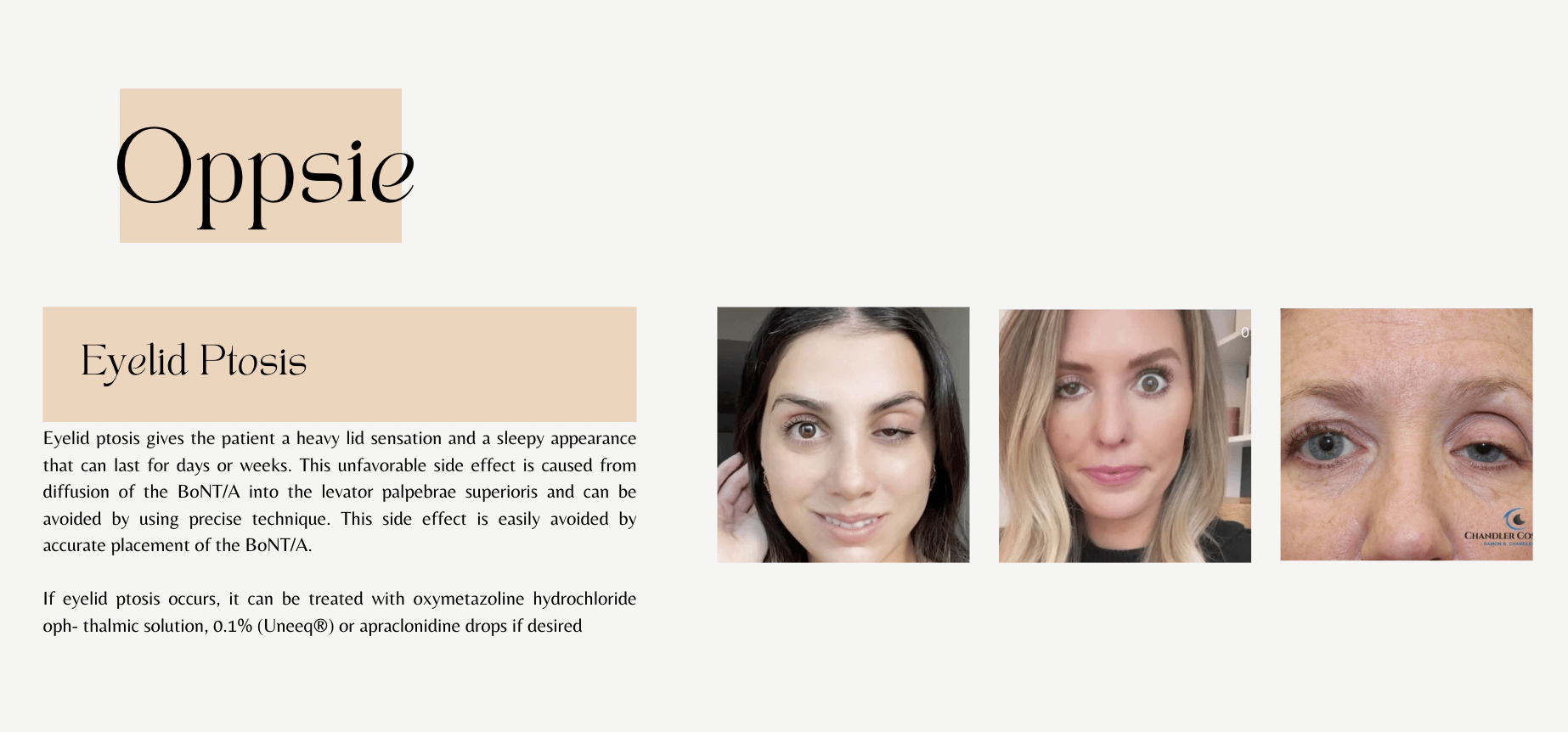
If this happens, you can either get a few balancing injections or just wait it out.
While it’s tempting to blame your injector, the truth is it’s kind of a crapshoot. For every 1,000 perfectly smooth humans, one unlucky soul pays the karmic debt for everyone else. And honestly? Even a little lopsided, you still look beautiful. I wouldn’t let this be the reason you skip Botox.
Allergic reaction a thing?
There’s also a very small percentage of people who experience allergic reactions to Botox—emphasis on very small. Most people will never have this issue, but in rare cases, your immune system can get a little dramatic about it.
What an allergic reaction could look like:
Localized redness or swelling that’s more than the typical injection-site puffiness
Itching or hives
Flu-like symptoms (fatigue, mild fever)
In extremely rare cases, difficulty breathing or swallowing (this is the “seek help now” kind of rare)
Why this happens:
Allergies can be triggered by the neurotoxin itself (botulinum toxin type A) or more commonly by the carrier proteins and stabilizers in the vial, like human serum albumin, lactose, or sucrose.
If you already have allergies to albumin or certain drug components, definitely tell your injector beforehand.
How it’s handled:
Most reactions are mild and self-limiting—think a little extra redness or itchiness that goes away.
Severe reactions are exceedingly rare, but if anything feels off beyond a normal post-injection sting, call your provider.
Bottom line: Allergic reactions are possible, but extremely uncommon, and any reputable injector will know what to look for and how to handle it.
Is it possible to develop immunity?
And finally, yes—Botox resistance is a thing… kind of. The frequency and degree are highly debated because it’s hard to test, and frankly, no one cares enough to conduct perfect studies. What we do know is this:
Resistance is more about frequent injections than true pharmaceutical resistance.
Botox works by blocking acetylcholine (ACh) at the neuromuscular junction.
Your neurons can compensate by producing more ACh, but only slightly and not forever.
Long story short: You’re probably not “resistant.” Adding more won’t help once you’ve hit the maximum therapeutic effect. Maybe you’re just stronger than Botox. Who knows.
The other, far more likely explanation? Botox is delicate.
If it sits too long outside a fridge, it loses potency.
If it gets too hot, it’s inactive.
So if you’re getting Botox from a place that isn’t maintaining lab-grade storage or has sketchy sanitary conditions, your injections might just be weak as hell.
What does the procedure entail? Is it painful? downtime?
When you arrive, your injector will assess your concerns and talk through what can realistically be done. They might point out areas you didn’t think needed treatment—not necessarily to upsell you, but because facial anatomy is a team sport. To get the results you want, sometimes nearby muscles need to join the party.
Example: If you want your forehead lines gone, you’ll probably need Botox in the glabella (the space between your eyebrows) as well. That’s an extra ~10–30 units there, plus ~12–30 units in the forehead.
If you only freeze the forehead but not the glabella? Congrats—you’ve just created new lines because you can still furrow your brow but can’t lift it.
Pain?
Botox uses a 32G needle—about the size of an insulin needle. I think the smallest one?Anyways, pain is usually a small pinch, though some areas are more tender than others.
Forehead / between the brows: Not bad.
Lips: Hurt like a bitch.
If you’ve ever had a vasovagal response to needles (lightheadedness, fainting), consider that this is your face, and the excitement might amplify things.
If pain is a concern:
Tell your injector ahead of time.
Topical lidocaine takes 30–40 minutes to kick in, so you’ll need to come early.
If you spring it last-minute, they may reschedule you—not rude, just logistics.
Finding the Right Injector
Botox is like getting a manicure: you’ll vibe with some injectors better than others. Don’t be afraid to shop around. Just like I can go to a million nail salons, but only Candy on Pico gets my gel X almond shape right every time.
After the Injection
Treatment time: 15–20 minutes
Immediate side effect: Sitting in your car, questioning your financial decisions
First 24 hours: You might feel muscles tighten even before you see results
7–10 days: You’ll start wondering why you didn’t do this sooner
Heads up: Early on, that tightening can feel like a tension headache or general achiness. Totally normal.
Post-Care Rules
Stay upright for ~4 hours*
Don’t rub the area
Skip cliff jumping and handstands. I know, tragic.
there is primary research behind the “~1 hour” idea—but it’s about the early molecular steps at the nerve terminal, not the visible effect.
Small nerdy tangent with links below. BoNT/A’s key steps happen quickly:
Binding to the nerve terminal has a half‑time ≈ 12 minutes.
Translocation/internalization into the nerve occurs with a half‑time ≈ 5 minutes.
The subsequent proteolytic (“lytic”) step—the part that disables release machinery—has a half‑time ≈ 55 minutes.
Put simply: within about an hour, most of the toxin that’s going to act has been taken up and is doing its intracellular job. But clinical onset lags Even though the molecular steps start within that first hour, the observable weakening at the muscle typically doesn’t begin for 1–3 days and peaks later. That delay is normal and well‑described in reviews.
About the “stay upright 3–4 hours” advice
Many clinical guides and reputable health systems recommend staying upright for 3–4 hours and avoiding rubbing/massage to minimize unintended diffusion. This is largely precautionary rather than based on a single definitive trial, but it’s widely taught as sensible aftercare.Technically, studies show the neurotoxin fully binds after 1 hour—but if you go skydiving at minute 61 and come back lopsided, don’t @ me (or your injector).
How long does Botox last?
Here’s the short version: most people get about 3–4 months out of their Botox, sometimes up to 6 months, and occasionally as little as 2 months if life is cruel.
But Botox longevity isn’t just luck—it depends on a few factors:
Your metabolism: If you burn through calories like a hummingbird with ADHD, you’ll probably burn through Botox faster too.
Your expressiveness: If you live life with a permanent Jim Carrey face, your muscles will fight to break free sooner.
The dose and the area: More units usually last longer, and big muscles (like the masseters) often hold Botox longer than small ones (like around the eyes).
Consistency: If you keep up with treatments, muscles slowly get used to being “chill,” and you may go longer between appointments or need fewer units over time.
My experience:
Sometimes it’s gone in 2 months (usually when I was stressed and making too many “I hate med school” faces).
Sometimes I’ve coasted for 5 months between appointments and forgot what my forehead even looked like when it moved.
Think of it like maintaining hair color—if you keep up with it, touch-ups are easier. If you skip too long, it’s like starting from scratch.
Botox for other purposes?
Most people know Botox as the “make me pretty” shot, but it moonlights as a legitimate medical therapy too. It can reduce chronic migraines, calm overachieving sweat glands, and ease jaw clenching or TMJ issues. If you’ve ever woken up with your jaw feeling like it went ten rounds with a brick wall, Botox can make your mornings significantly more peaceful.
That said, please don’t go to the discount med spa for jaw Botox. Your jaw is a complex joint with multiple muscle groups interacting, and blindly injecting the standard “30-unit masseter package” is like trying to fix a Swiss watch with a hammer. If you want it for TMJ or clenching, see a dentist or a provider who understands your bite mechanics. This is one area where Groupon is not your friend.
Are there any alternatives to Botox?
Yes. Shit tons and shit tons. They all have the same underlying modality- but every country has its own selection of candy at the checkout aisle.
Who is not a suitable candidate for Botox?
Pregnant or Breastfeeding
Botox is generally safe for most people, but there are a few exceptions. If you’re pregnant or breastfeeding, every provider is going to tell you no. Not because Botox has been proven dangerous, but because no one is funding a “let’s inject pregnant women and see what happens” study. Retrospective studies aren’t exactly easy to justify either. Providers like keeping their medical licenses, and the simplest way to do that is not injecting your pregnant self, no matter how smooth your forehead dreams may be. Personally, I’ll admit that when I’m pregnant, I might still get Botox because I aspire to be a negligent mother with perfect skin—but I wouldn’t recommend using me as your moral compass.
blackbox warnings
People with certain neuromuscular disorders, like myasthenia gravis or Lambert-Eaton syndrome, are also typically excluded, since Botox could worsen their symptoms.
Allergies to Botox or its ingredients are rare, but possible, see above.
If you already have significant muscle weakness in the area you want treated, Botox probably isn’t for you.
And finally, if you’re on medications that interfere with neuromuscular transmission or that thin your blood, or if you have an active infection at the injection site, you’re going to need to wait. Nobody wants to turn a pimple into a malpractice suit.
How much does Botox cost?
Here’s the part that stings more than the needle. Botox is priced by the unit, and you’re usually looking at somewhere between $8 and $15 per unit. Treating a forehead, the space between the brows, and the crow’s feet can easily land you in the $200 to $300 range. I’ve paid $500 before because LA med spas are bold and shameless. I’ve also paid $150 once because of a promotion so sketchy I’m pretty sure they stole my Social Security number—but honestly, worth it.
If you want to save money, ask for the price per unit up front. A lot of med spas hide behind “area pricing,” which makes it impossible to know if you’re paying a fair rate or funding their next Tesla lease. Rewards programs like Alle and Aspire exist, and they’re basically Botox punch cards—you only get the discount if you remind them to stamp it. Some clinics even offer annual memberships or flat-fee “per area” deals, which can be worth it if you’re committed to maintaining your smooth little face all year.
Of course, my personal cost-saving strategy is less conventional. I booked as many consults as possible, strategically dated a dermatologist, and now I live with him and steal the rep samples for free. Highly effective. Highly recommended if you can pull it off.
Final Thoughts
Botox is:
Safe
Effective
Entirely optional
It’s personal, reversible, and a little addictive—but in a fun way. Like gel nails for your face.
If you’ve got facial asymmetry, migraines, TMJ, or just want to stop that one concealer-eating wrinkle, Botox might be your new best friend.
Anyway, thanks for coming to Botox Church. Drop your face questions—or favorite Amazon thong recs—in the comments. I will absolutely respond to one and buy the other.
k. love you. bye.